



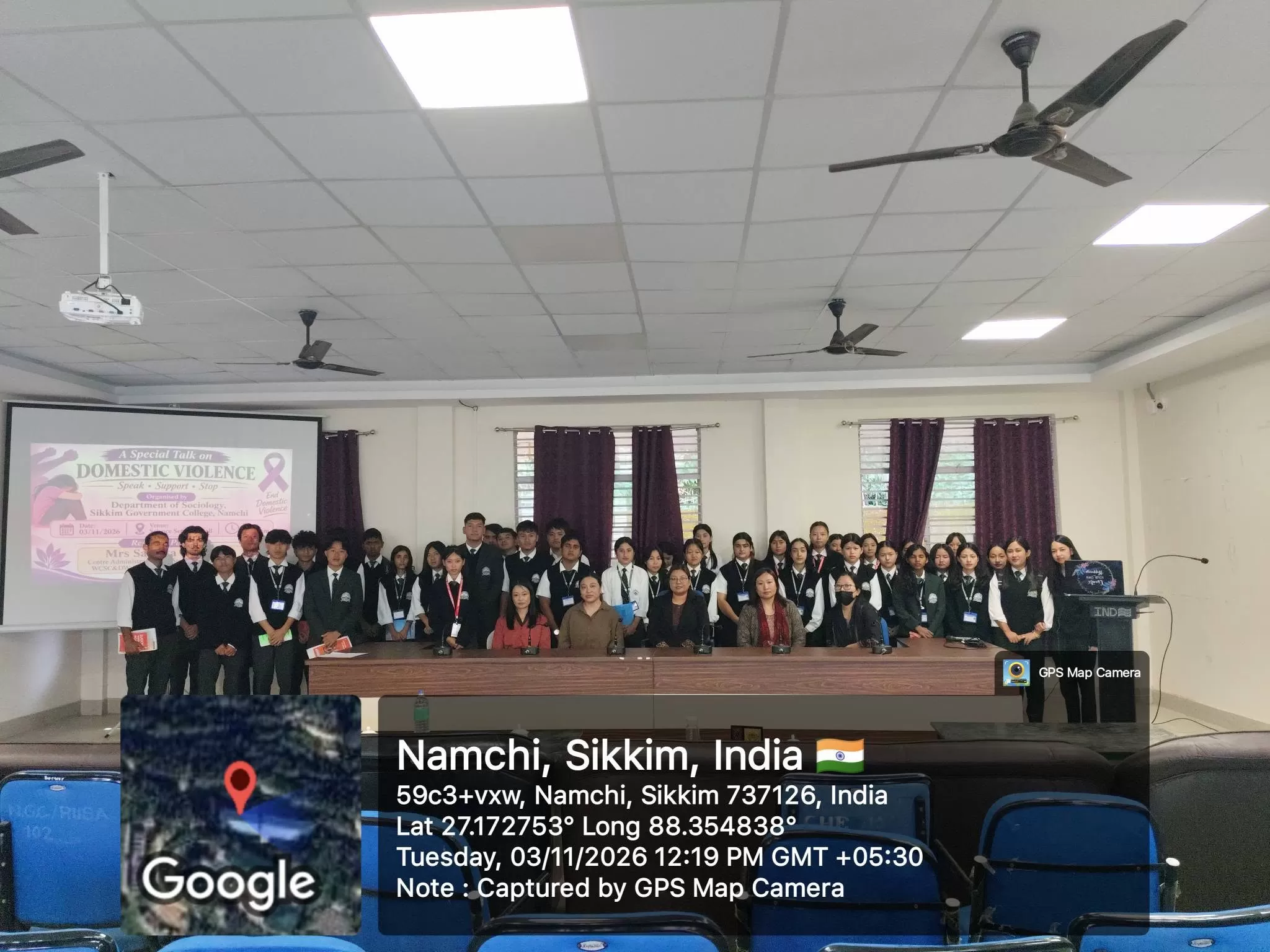
The Department of Sociology, Sikkim Government College, Namchi, organised a talk cum awareness programme on the Protection of Women from Domestic Violence on 3 November 2026 at 10:30 a.m. in the Seminar Hall of the college.
The programme was attended by the faculty members of the Department of Sociology along with the 1st and 5th semester Sociology Honours students. The programme was facilitated by Mrs. Sangita Gurung, Centre Administrator of the One Stop Centre, Jorethang, under the Women, Child, Senior Citizen and Divyangjan Welfare Department, and was anchored by Ms. Semant Adhikari, a 1st semester Sociology Honours student.
The program commenced with a warm welcome address delivered by Mrs. Sushmita Gurung, Head of the Department of Sociology. She welcomed the resource person, faculty members, and students, and highlighted the importance of providing a practical understanding and experience on the topic through the Resource person. She highlighted the issue of domestic violence to be very relevant to the student of sociology where the causes is deeply rooted in the patriarchal nuances of the society. She also highlighted the discussion will bring awareness about women’s rights, cases of domestic violence, and the legal remedies available to the victims.
The resource person began her presentation titled “Presentation on Protection of Women from Domestic Violence Act, 2005.” She first introduced the One Stop Centre and explained why such centres were established after the Nirbhaya rape case. She explained that the Centre was created to provide integrated support to women affected by violence under one roof. She informed the audience that the One Stop Centre provides legal aid, psycho-social counselling, short-stay shelter facilities, medical assistance through paramedical staff, and police assistance for helpless victims. She further stated that the Centre functions 24 hours a day, seven days a week, so that women in distress can seek help at any time.
Mrs. Gurung also explained the shelter facilities available for victims. She mentioned that earlier, shelter was provided for about five days, but the duration has now been extended to almost twenty days. For women requiring longer-term support and rehabilitation, she described Sakhi Sadan as an important facility. She also informed the students about the Women Helpline 181 and the Child Helpline 1098, which provide immediate assistance and support to women and children in need.
The speaker then explained the definition of domestic violence under the Protection of Women from Domestic Violence Act, 2005. She clarified important terms such as “aggrieved person,” “domestic relationship,” and “respondent.” She explained that an aggrieved person is a woman who has faced or is likely to face domestic violence, while a respondent is the person against whom the complaint is made. She also explained that a domestic relationship refers to a relationship in which the persons live or have lived together in a shared household.
Mrs. Gurung further discussed the different types of violence recognised under the Act. She explained physical violence, verbal and emotional violence, sexual abuse, and economic or financial abuse. She stated that physical violence includes acts causing bodily harm or danger, while verbal and emotional violence includes insults, humiliation, threats, and behaviour causing mental agony. While discussing sexual abuse, she explained that it includes sexual jokes, marital rape, uncomfortable touch, and showing pornography. She also briefly explained economic and financial abuse as the control or denial of a woman’s access to money, resources, or financial support.
The resource person then explained the procedure for seeking legal protection. She informed the students that a victim may approach the Protection Officer, who prepares a Domestic Incident Report (DIR) and submits it to the Judicial Magistrate. After considering the report and hearing the parties, the Magistrate may issue a protection order and provide relief to the victim. She explained that the protection order prevents the accused from committing further violence or contacting the victim. She also stated that violation of a protection order by the accused may lead to punishment, including imprisonment for up to one year.
The presentation was followed by an interactive session in which students actively participated and asked questions. During this session, Mrs. Gurung also highlighted the POCSO Act and discussed cases related to sexual offences against children. She further spoke about child trafficking and the importance of rehabilitation and support for affected children. During the interaction session, students enquired about the support available to male victims of domestic violence. In response, the resource person stated that male victims also approach the One Stop Centre, where they receive counselling and are guided towards suitable legal assistance and support services.
The programme concluded with a vote of thanks delivered by Mr. Ujjwal Gurung, a 5th semester Sociology student. He expressed gratitude to the resource person for her valuable and informative presentation, to the Head of the Department for organising the programme, and to the faculty members and students for their active participation. The programme was highly informative and helped students understand the legal provisions against domestic violence, the services of the One Stop Centre, and the helplines available for women and children.